
Business With Blain: R.I.P. Bill Kenwright
JohnB reflects on Bill Kenwright's legacy.

Prior to becoming a Board member at the club he loved, Bill Kenwright was probably best known to most Evertonians as the actor who played Gordon Clegg in what is now the world’s longest-running television soap opera – Coronation Street.
As a new member of Everton’s Board and bursting with pride, he could hardly have envisaged that his fame, both positive and negative, would become irrevocably linked to the on-field success of his beloved football club.
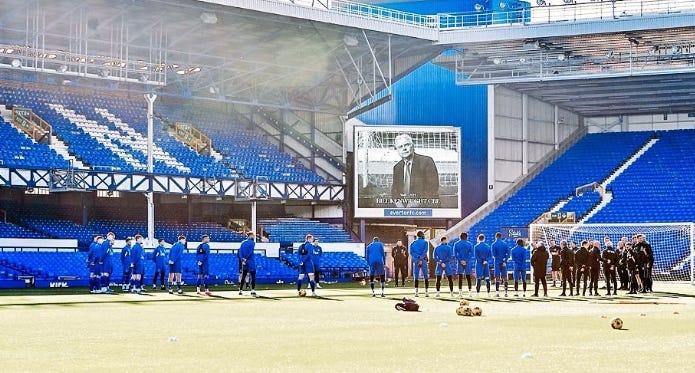
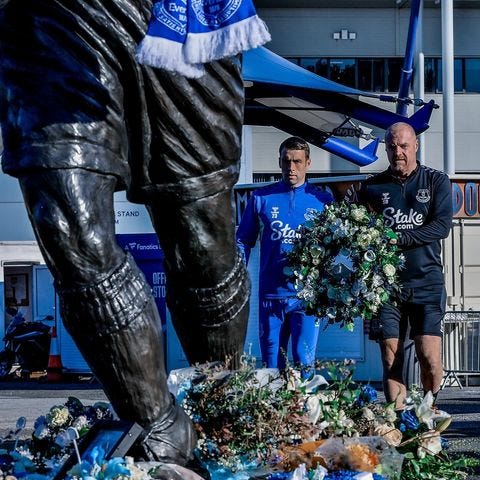
Kenwright joined the Board in 1989 and became the second-largest shareholder in the club a decade later, before becoming the majority shareholder and Chairman in 2004. Despite selling to Farhad Moshiri in February 2016, he continued to hold the post until he passed away, surrounded by his family, on October 23rd, 2023.
He was 78, and is survived by his partner Jenny Seagrove, as well as his daughter, Lucy.
His acquisition of the club was initially received positively, and his appointment of David Moyes — a bright young manager who had worked wonders with Preston North End — in 2002 heralded an era of on-pitch stability at Everton, though financial struggles meant there was always a perceived glass ceiling that the Toffees seemed unable to break through.
A glass ceiling that Kenwright believed couldn’t be breached until the club enjoyed the buying power that only a billionaire owner could bring.
“It’s incredibly sad news. He was a wonderful man, he gave me a big opportunity in my career, taking me when I was a young manager in the lower leagues and gave me a job in the Premier League. Brilliantly supportive. I couldn’t have had a better chairman as a young coach. When I look at modern football nowadays, how difficult it is for any young managers to make their way, Bill Kenwright was great to work with.”
David Moyes
A move to a new stadium at the King’s Dock should have provided the financial power to compete with the Premier League’s growing elite, but Kenwright, amid a public feud with Director Paul Gregg, was unable to secure the funding until it was too late.
In 2004, superstar youngster Wayne Rooney was sold to ease the financial burden on the club, but the following season, Moyes guided Everton to a fourth-placed finish; a position that remains their highest in the Premier League era.
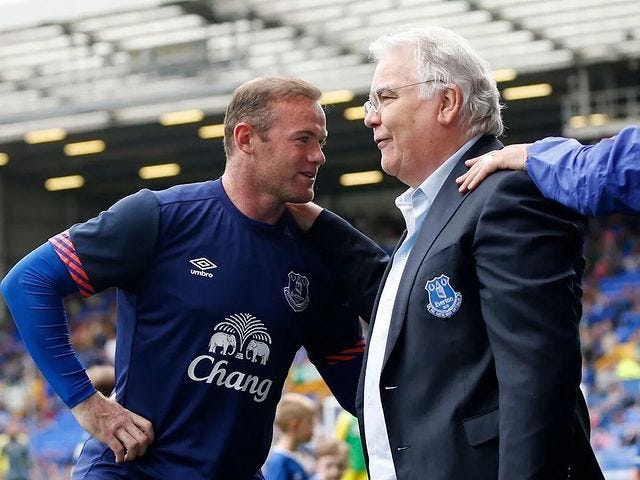
A proposed buyout of 29.9% of the club from Fortress Sport Fund (FSF) fell through in 2004, and fans called for the Board to resign, yet Kenwright stayed in place.
Three years later, Kenwright said that Goodison Park would fail to obtain a ground safety certificate and that the solution was a move to an identikit stadium in the town centre of Liverpool suburb Kirkby. The project would have included the construction of the new stadium; a Tesco supermarket and retail park would also have bordered the ground.
Minority shareholders voted against this proposal but were overruled by the majority shareholders — led by Kenwright. However, the project was called in by the Secretary for State and a public inquiry, led from the fans’ side by ‘Keep Everton in Our City’ — a group that determined that the proposed stadium move should not proceed.
It’s fair to say that Kenwright subsequently had an uneasy relationship with the fans that remained an ever-present facet of his tenure from then on.
“It's a very sad time for everyone at Everton Football Club to lose our Chairman, someone who has been such an amazing servant to the Club in so many ways. His influence in bringing me to Everton in the first place was important and I have nothing but gratitude and respect for his unwavering support of myself, the staff and our players. It was a pleasure to share the moment of reaching our objective last season with him – a moment I know he felt so strongly about after such an arduous season, on and off the pitch.”
Sean Dyche
The Blue Union protests of the late 2000s and early 2010s were scoffed at by Kenwright and did not always garner enough favour from the wider fanbase, consequently failing to gain the momentum that would surely have made the club’s history substantially different.
Kenwright likely always had Everton’s best interests at heart, but by the time he finally relinquished control in 2016, it was to British-Iranian billionaire Moshiri, with Kenwright retaining the Chair and some element of power. Albeit, it is understood his influence has very much been diluted as the years have gone by as he failed to control the apparently impulsive nature of the new largest shareholder.
He continued to play a pivotal role in the chaos that has engulfed Everton since 2016. More Than A Game understands that despite Everton being on their third Director of Football since Moshiri’s arrival, Kenwright, rightly or wrongly, continued to take an active — often leading — role in transfer negotiations, while it is often referenced in the national and local media that Everton’s leadership became split into two camps: those working from Merseyside, and those based in London (namely Moshiri and Kenwright).
If it was not already, Kenwright’s position was made entirely untenable in January 2023, when he and the rest of Everton’s Board did not attend a home game against Southampton, with stories leaked to the press of the CEO having been placed into a headlock at a previous match, and with a club statement informing fans that the Board had been advised not to attend due to concerns over their safety.
The Board, and specifically Kenwright, did not attend another home match last season or indeed at all, as three of the four members resigned and left the club soon after the end of the campaign. Kenwright was expected to follow suit, but was convinced by Moshiri to remain in his post through the summer, and he continued to take an active part in the running of the Club until his sad death.
His intentions may have been good, but Everton had long needed change and over time Kenwright became part of the problem. His trust in some of the people around him was possibly misplaced and too often he was overruled by owners and employees alike who lacked his experience and emotional investment in Everton.
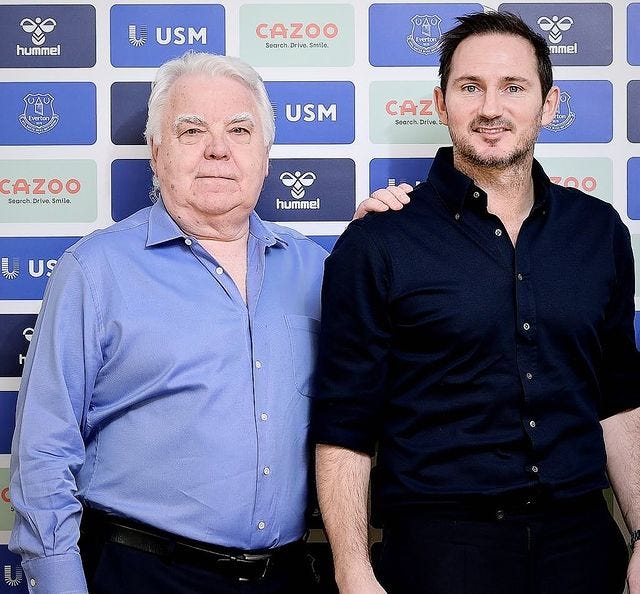
In 2021, Kenwright claimed that Everton’s Board was revered by their Premier League rivals.
Just two years later, each of those “revered” members have been replaced – some had left as soon as the kitchen got too hot — and he faced Everton’s challenges alone — he cut a lonely and forlorn figure at the London Stadium following a 2-0 loss to West Ham back in January.
In the past 18 months, the club has endured two relegation battles, been charged for a breach of the league’s financial rules (which according to reports on Wednesday, may yield a 12-point deduction as an incredibly harsh punishment), and is now the subject of a takeover attempt by 777 Partners, a private investment firm not without its own share of controversy.
So how will Bill Kenwright CBE be remembered in a world of instant fame and often cancellation, in a clickbait era that puts far too much onus on social media platforms that are often referenced as an echo chamber of the worst behaviours our society has to offer?
“The thing I read a little bit recently, obviously [he had] a massive heart for the city and a massive heart for Everton, but the message he gave around Hillsborough, the speech he gave, I heard about — that they chose the wrong city and the wrong mums — that’s a really, really strong message.”
Jurgen Klopp
The question will be answered differently depending upon where you stand around the circle of perception. From where I stand, there are three versions of the man: There is Chairman Bill, the man known to Everton fans and most of the club’s employees; there’s William Kenwright CBE, successful Theatre and Film Producer; and there’s Bill Kenwright, the one people closest to him, or those that spent one-to-one time with him, knew.
It's fair to say that Chairman Bill will be the one least liked — he could be harsh and aggressive, often myopic, and dismissive when considering the views of those critical of his leadership.
A good example of Chairman Bill lashing out came ahead of a trip to Crystal Palace in April, in the form of a bizarre open letter to fans. Even if Chairman Bill’s intentions came from the right place, his actions and words — at least in recent years — often made things worse, not better.
The popular perception of that person isn’t positive at all, and is also at odds with how he is perceived in the community he spent most time with during his life. He is genuinely revered and respected in the theatrical world, with success and failures common to that industry being treated equally.
The version I prefer is the one I got to know over hours of one-on-one discussions in his London HQ at Venice Walk; the long climb up the stairs to his large office was always one of anticipation, but the harshness of Chairman Bill would swiftly be replaced by the ‘real’ Bill as soon as our often-confrontational shareholder business had concluded.

His office, with two battered and comfortable sofas, was the theatre for long debate about football and of course Everton in particular. The white baby grand piano, played with regularity by such luminaries as Sir Andrew Lloyd-Webber and Sir Paul McCartney, was flanked by countless theatrical awards but also, and with equal billing, a cabinet and a wall full of memorabilia from his other love — Everton.
This Bill was a delight to be with. This Bill could talk candidly about the other versions of himself.
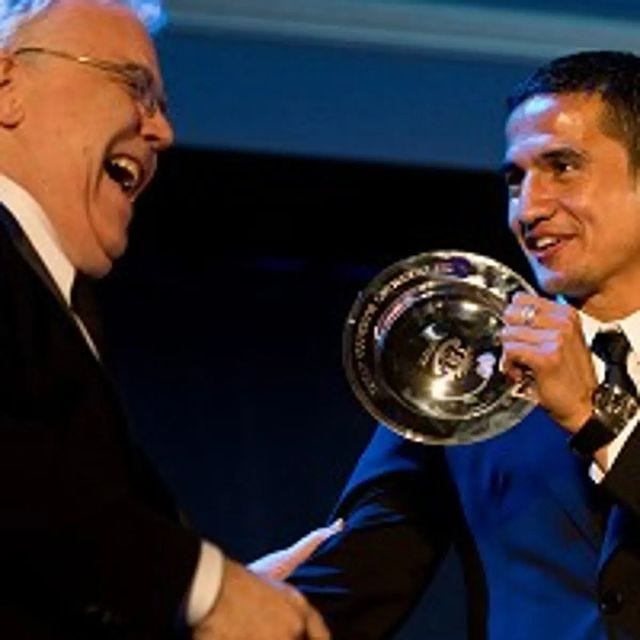
He never quite appeared to grasp why he was so popular with his theatrical and wider football associates but never quite got there with the group he wanted that adulation from the most — the wider Everton fanbase.
The real Bill, I’m sure, would be pleased with his performance as an impresario but less so as the leader of a football club, but I hope that most people will share my view that he was a good man, a passionate Evertonian who did his best for his football club.
It wasn’t quite good enough, and given his time again I’m sure he would do things differently. Nonetheless, all we Evertonians ever say we want from our players is that they try their best — that they try and be the best version of themselves that they can be.
I believe Bill Kenwright did just that.
By JohnB
Good summary and I agree he did his best. Nobody can deny his passion for both Everton and the theatre and it's just a pity his success in the footlights wasn't repeated under the floodlights. RIP Bill, a warm and compassionate man.